
Seven asset blind spots let attackers past your security operations center (SOC): cameras and IoT devices, data center power and cooling, plant Windows PCs, plant network and field devices, internet-exposed controllers, programmable logic controllers (PLCs) that keep no logs and the IT systems production depends on. Left unwatched, they become enterprise ransomware, data center outages and weeks of lost production. Mithryl Systems OT managed detection and response (OT MDR) monitors your operational technology (OT) around the clock and investigates every significant event, including what the affected asset can shut down.
CISA and eight partner agencies define an asset inventory as "an organized, regularly updated list of an organization's systems, hardware, and software," and warn that without one, organizations "do not know what they have and what should be secured and protected." Each blind spot below sits on your network and sends your SOC nothing it can act on.
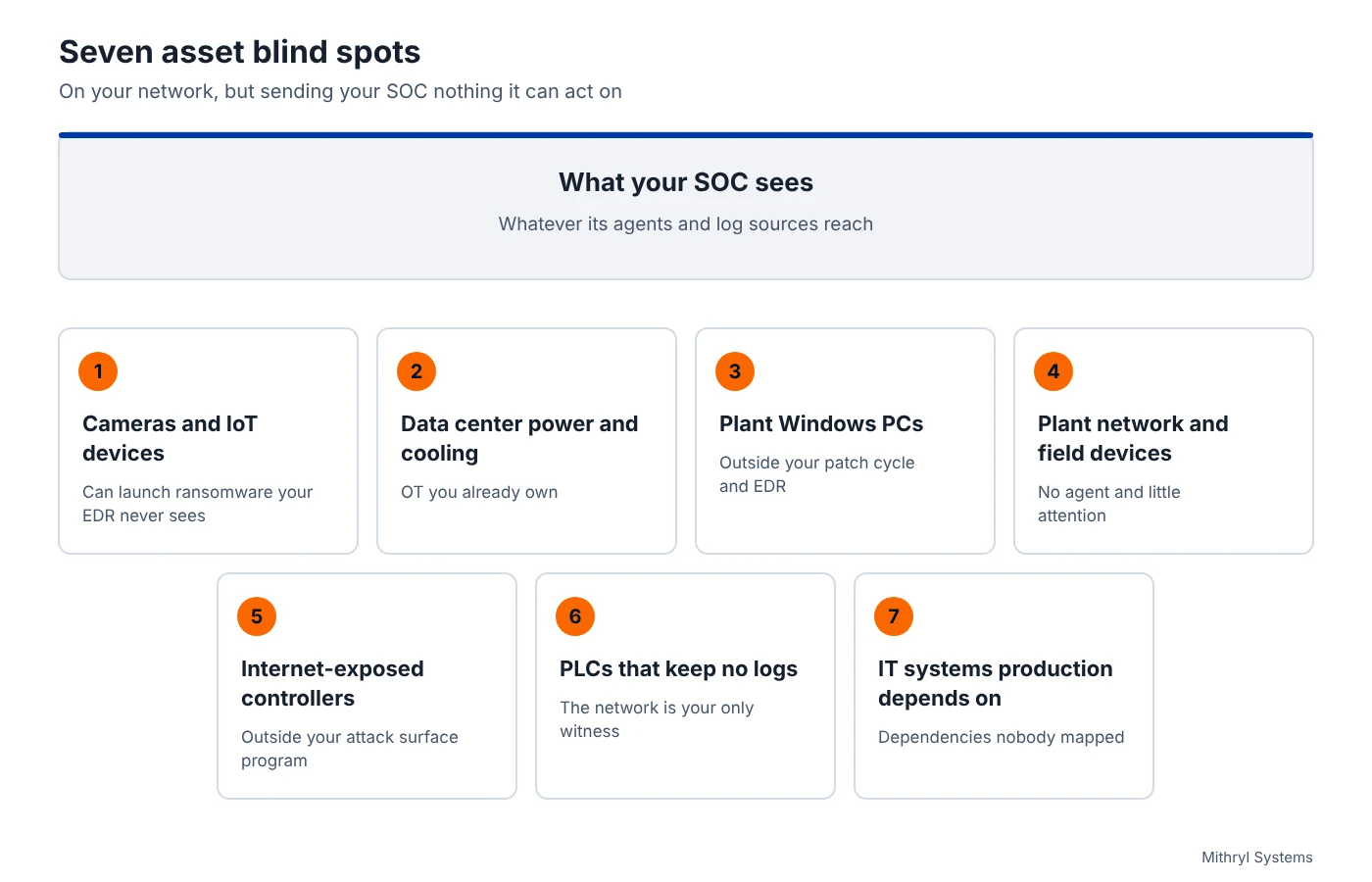
Seven asset blind spots that sit on your network but send your SOC nothing it can act on
1. Cameras and IoT Devices Can Launch Ransomware Your EDR Never Sees
The easiest way around endpoint detection and response (EDR) is a device that can't run it. In a case incident response firm S-RM published in March 2025, the victim's EDR quarantined the Akira ransomware gang's Windows encryptor before it ran. The attackers had already scanned the network and found webcams.
They took over one running a lightweight Linux operating system, launched Akira's Linux version from it and encrypted files across the network over SMB. The camera had no EDR, likely because it lacked the storage, and nobody was monitoring its traffic.
The EDR did its job, and the company still got encrypted. A camera has no business opening file shares on a server, and network monitoring can flag that.
2. Data Center Power and Cooling Are OT You Already Own
Uninterruptible power supplies (UPS), power distribution units and cooling controllers keep your servers running. CISA and the Department of Energy warned in 2022 that attackers were getting into internet-connected UPS devices, often with default passwords, and noted that IT, building operations or outside vendors could each be responsible for them.
The flaws are serious. In 2025, CISA published two vulnerabilities rated 9.8 out of 10 in Vertiv UPS network cards, reported by Claroty's Team82. In their technical write-up, presented in June 2026, the researchers said a remote attacker could switch a managed UPS's output off. Team82 also warned that HVAC controller failures can cause thermal shutdowns and hardware damage.
That's a data center outage without malware on a single server.
3. Plant Windows PCs Sit Outside Your Patch Cycle and EDR
Human-machine interfaces (HMIs), engineering workstations and tool PCs are Windows computers that run a physical process, and many sit outside the patch cycle and EDR. In August 2018, TSMC connected a new tool to its network before confirming it was virus-free. A WannaCry variant spread to fab tools and automated materials handling systems running unpatched Windows 7, according to TSMC.
Customer data wasn't affected. TSMC first put the hit at about 3% of third-quarter revenue, then lowered it to no more than 2%.
In TXOne Networks' 2026 survey of 550 industrial decision-makers in six European countries, 60% said legacy Windows makes up at least half of their OT environment. Mithryl Systems monitors HMIs and engineering workstations and builds OT detections for unauthorized engineering activity and deviations from asset baselines.
4. Plant Network and Field Devices Get No Agent and Little Attention
Routers, firewalls, serial servers and field controllers in the plant can't run EDR, and integrators often manage them, so they drift out of the network team's inventory. On December 29, 2025, attackers struck at least 30 wind and solar farms, a combined heat and power plant and a manufacturer, according to CERT Polska, the national cybersecurity team. They got in through internet-facing FortiGate VPNs that didn't require multifactor authentication.
At the substations, they corrupted firmware on remote terminal units (RTUs), disabled protection relays and factory-reset serial device servers and FortiGate firewalls, cutting the sites' link to the grid operator. Generation continued.
At the heat and power plant, EDR stopped the wiper. At the farms, controllers and relays that can't run an agent were bricked. Forescout's 2026 riskiest devices report ranks routers first.
5. Internet-Exposed Controllers Sit Outside Your Attack Surface Program
Some of your OT may be reachable from the internet through a cellular modem or a vendor's install, outside the IP ranges you scan. Censys counted about 134,000 internet-exposed hosts running industrial control system services in early 2026, more than 40,000 of them in the U.S. About 70% sat on consumer and mobile networks, where records point to the carrier, so researchers often can't identify the owner.
Attackers don't need to. Starting in November 2023, the Iran-linked CyberAv3ngers took over internet-exposed Unitronics controllers at multiple U.S. water facilities using default passwords, according to a joint advisory from the FBI, CISA, NSA and partners. CISA's first OT mitigation, published in May 2025, is blunt: "Remove OT connections to the public internet."
6. Controllers Send No Logs, So the Network Is Your Only Witness
PLCs are small single-purpose computers that open valves and run pumps. They don't run agents and log little, so their network traffic is the evidence. In January 2024, attackers used malware Dragos named FrostyGoop to send Modbus commands to heating controllers at a Ukrainian district energy company.
More than 600 apartment buildings lost heat in sub-zero temperatures, and remediation took almost two days. The attackers also downgraded controller firmware to remove monitoring capability. Dragos says they may have entered through an internet-facing router months earlier.
Dragos recommends continuous Modbus monitoring, and its detections flag external connections and first-time writes. Mithryl Systems OT detection engineering covers Modbus and other industrial protocols, with detections for anomalous control commands.
7. Production Depends on IT Systems Nobody Mapped
ERP, ordering and logistics systems are IT assets, but production often stops when they do, and few inventories record that dependency. Jaguar Land Rover began shutting down systems after a cyberattack on September 1, 2025, and built no cars for about five weeks. The UK's Cyber Monitoring Centre estimated the economic impact at £1.9 billion, mostly lost manufacturing output.
At Colonial Pipeline in 2021, a ransom note found on an IT system led the company to shut all 5,500 miles of pipeline that morning to keep the malware from spreading. When nobody knows what an asset can stop, containment can become the outage. Mithryl Systems investigations include asset identification and impact analysis, and Mithryl Systems OT vCISO services map crown jewels, critical processes and assets.
An Asset List Versus Asset Coverage
The difference shows up the moment something goes wrong.
| Compared on | Asset inventory alone | Assets in security coverage |
|---|---|---|
| What you learn | What exists, where and what it runs | What it's doing and whether that's normal |
| Cameras and IoT | A line on a facilities spreadsheet | An alert when a camera opens file shares |
| Controllers | Make, model and IP address | Alerts on writes, firmware changes and new connections |
| During an incident | A criticality column, if anyone filled it in | Impact analysis that informs what to contain |
Frequently Asked Questions
Can our existing SOC monitor OT assets?
Partly. Your SOC sees what its agents and log sources reach, and most controllers, cameras and plant network gear send it nothing. Mithryl Systems OT MDR extends your existing SOC with OT expertise, continuous investigation and operational context.
Can we extend our EDR agents to cover OT?
Only for part of the estate. Some Windows HMIs and engineering workstations can run an agent, though CISA's April 2026 zero trust guidance for OT notes that EDR agents "require extensive compatibility testing and may impact system warranties." Controllers, network gear, cameras and power systems generally can't run one, so the guidance favors passive monitoring and compensating controls, including enhanced monitoring.
Is it safe to scan OT networks to find assets?
Not with IT-style scans. Dragos warns that older OT devices "may freeze, crash, or become unresponsive" under scanning queries. Passive network monitoring is the safe default, with targeted queries tested first and scheduled with operations during planned downtime.
Do we need to replace our security tools to cover OT assets?
No. Mithryl Systems integrates with existing OT monitoring platforms, SIEM, EDR, firewalls, identity, VPN and remote access tools, and onboarding starts from your asset inventory and critical asset identification.
Review Your OT Detection Coverage, Asset by Asset
Each of these seven asset blind spots can stop the business. Mithryl Systems OT MDR monitors 24x7, correlates activity across enterprise IT, the DMZ and OT, and investigates before it escalates, including asset identification and impact analysis. When an investigation exposes missing telemetry, that gap feeds visibility improvements.
Talk to Mithryl Systems about your OT detection coverage: which assets your SOC sees, which it doesn't and what each could shut down.
Sources and Further Reading
- CISA, EPA, NSA, FBI and international partners, Foundations for OT Cybersecurity: Asset Inventory Guidance for Owners and Operators (August 13, 2025)
- S-RM, Camera off: Akira deploys ransomware via webcam (March 5, 2025)
- CISA and U.S. Department of Energy, Mitigating Attacks Against Uninterruptible Power Supply Devices (March 29, 2022)
- CISA ICS advisory ICSA-25-140-10, Vertiv Liebert RDU101 and UNITY (May 20, 2025)
- Claroty Team82, Attacking UPS Network Cards to Take Down Data Centers (presented June 2026)
- Claroty Team82, Turning Up the Heat: Hacking Trane HVAC Controllers (June 9, 2026)
- TSMC, Form 6-K (August 5, 2018)
- TSMC, Form 6-K (August 6, 2018)
- TSMC, statement on the virus incident (August 2018)
- TXOne Networks, The Legacy OT Dilemma Part 2: The 2026 Update (May 14, 2026)
- CERT Polska, Energy Sector Incident Report 2025 (January 30, 2026)
- Forescout, Riskiest Connected Devices in 2026 press release (March 23, 2026)
- Censys, 2026 State of the Internet: The Exposure Notification Gap in ICS Devices (September 8, 2026)
- FBI, CISA, NSA, EPA and Israel National Cyber Directorate, Joint Cybersecurity Advisory AA23-335A (December 1, 2023, updated December 14, 2023)
- CISA, FBI, EPA and DOE, Primary Mitigations to Reduce Cyber Threats to Operational Technology (May 6, 2025)
- Dragos, FrostyGoop ICS Malware Intel Brief (July 2024)
- Security Affairs, Cyberattack on Jaguar Land Rover inflicts $2.5B loss on UK economy (Cyber Monitoring Centre estimate, October 2025)
- U.S. Senate Homeland Security and Governmental Affairs Committee, testimony of Colonial Pipeline CEO Joseph Blount (June 8, 2021)
- CISA and partners, Adapting Zero Trust Principles to Operational Technology (April 29, 2026)
- Dragos, Enhancing OT Visibility: Understanding the Time and Place for Active Collection (April 2025)